
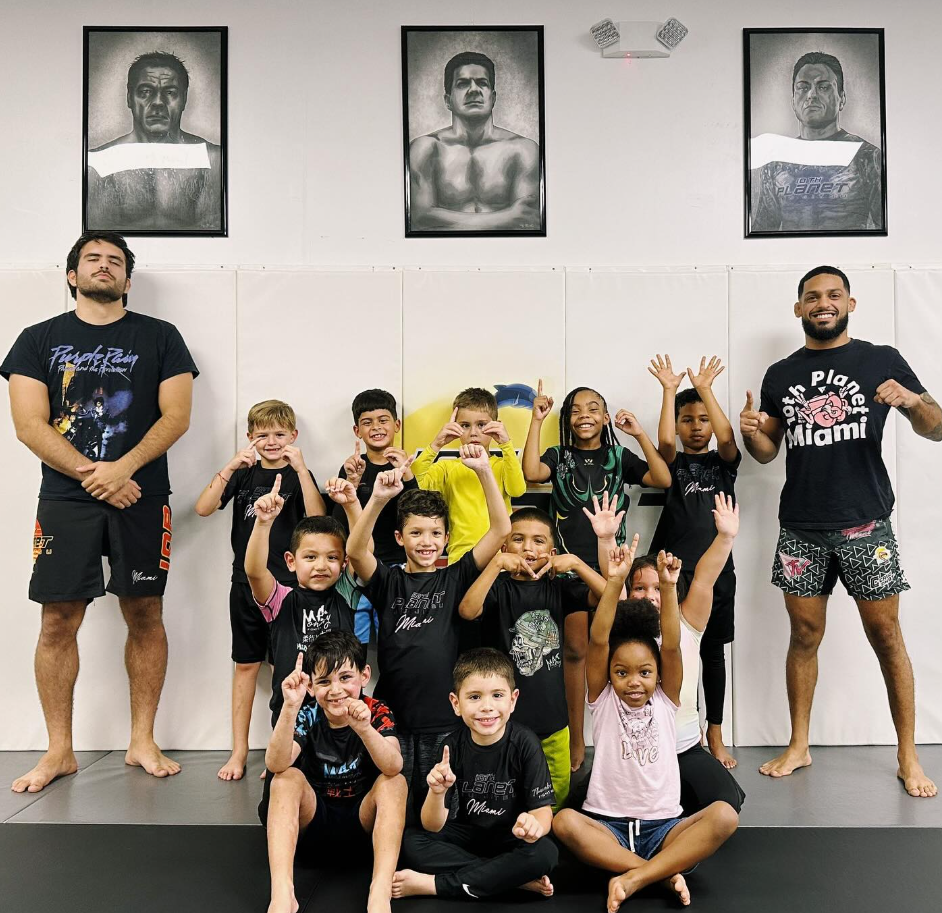
Youth Jiu-Jitsu turns everyday kid problems into teachable moments your child can actually practice, safely, on the mats.
Parents around Miramar ask us a version of the same question all the time: will Youth Jiu-Jitsu help my child outside the academy, or is it just another activity to burn energy? Our answer is simple. When training is structured well, kids walk out with skills that show up at school, at home, and in social situations where pressure feels real.
There is also a growing body of evidence behind what families notice anecdotally. A 2024 survey reported that 96.4 percent of parents observed improved confidence, 87.5 percent saw reduced anxiety, and 96.4 percent saw life skills transfer into daily life. Those numbers line up with what we see in class when kids start standing taller, speaking more clearly, and handling frustration with a little more patience than they used to.
In Miramar, we also see a few modern challenges hitting kids all at once: lots of screen time, more sedentary routines, and social stress that does not always look like it did when we were kids. Youth Jiu-Jitsu in Miramar gives your child a place to move, problem-solve, and learn how to handle close-contact situations with control instead of panic.
Why Youth Jiu-Jitsu works for real life, not just the mats
A big reason Brazilian Jiu-Jitsu helps kids is that it is a thinking sport. In many classes, your child is not trying to be the fastest or the strongest in a straight line. We are teaching how to stay calm, create options, and make good choices while someone is resisting. That is basically a kid-friendly version of real-world stress management.
Another reason is the environment. We train with clear rules, coached intensity, and constant reminders about respect. Kids learn quickly that technique and patience beat wild reactions. Over time, that mindset becomes a default setting, which is exactly what you want when your child is dealing with a tough teacher, a rude classmate, or a stressful test week.
Research also supports the mental side. Training correlates with mental strength, resilience, grit, self-efficacy, and self-control, and advanced practitioners tend to score higher than beginners. In youth-focused studies, martial arts training has been linked to reductions in emotional symptoms and hyperactivity after structured training blocks. We keep our coaching age-appropriate, but we do not talk down to kids, because they can absolutely learn emotional regulation when it is practiced consistently.
Confidence that is earned, not hyped
Confidence is not a pep talk. It is proof. In Youth Jiu-Jitsu, kids earn confidence in small, repeatable ways: remembering a sequence, escaping a pin, asking a question, trying again after a mistake. Those moments stack up.
We also build confidence by letting kids feel what controlled challenge is like. That matters because many kids either avoid discomfort completely or get overwhelmed when it shows up. On the mats, we can dial intensity up or down and teach your child to keep breathing, keep thinking, and keep moving.
Here is what that looks like in real life. A confident kid is more likely to speak up when something feels unfair, more likely to make eye contact, and less likely to fold when a friend pressures them. That does not mean your child becomes loud or aggressive. Usually it is the opposite. The more capable kids feel, the less they need to prove anything.
Practical anti-bullying benefits without teaching kids to fight at school
Parents often ask about bullying. We treat this carefully because the goal is not to create hallway heroes. The goal is to reduce your child’s risk and increase your child’s options.
Data points here are encouraging. Youth training that builds assertiveness and self-defense skills has been associated with a 50 percent lower bullying risk, and families report meaningful gains in peaceful problem-solving. In our classes, we focus on awareness, boundaries, and the ability to control distance and grips. Your child learns what to do if someone grabs them, crowds them, or tries to pull them down. Those are common scenarios in youth conflicts.
We also coach the non-physical side. If your child can name what is happening, keep composure, and get an adult involved early, problems shrink. And if something escalates, we train kids to protect themselves without unnecessary harm. That balance is a big part of why families choose Jiu-Jitsu in Miramar, FL as a practical option for everyday safety.
Resilience and focus: the hidden superpower
Resilience is trendy as a word, but it is very real as a skill. It is the ability to recover, re-engage, and keep learning after setbacks. Youth Jiu-Jitsu is full of manageable setbacks, which is exactly why it works.
A 2024 study involving martial arts trainees reported that regular training improved resilience and focus, with neuroscience-backed explanations around attention and stress response. In plain language, training helps kids practice directing attention under pressure. We see this when a student stops freezing and starts troubleshooting: move the hips, frame correctly, recover guard, try again.
Focus improves for a practical reason too. Techniques have details. If your child daydreams, the technique does not work, and the feedback is immediate. Over time, kids begin to value listening, asking questions, and applying corrections. Those habits transfer naturally into schoolwork, chores, and conversations at home, which is why parents often connect Youth Jiu-Jitsu to better overall discipline and follow-through.
Physical development that supports growing bodies
Kids do not need bodybuilding. Kids need coordinated movement, balance, and body awareness. Jiu-Jitsu is excellent for that because it builds strength through natural patterns: bridging, shrimping, standing up safely, controlling posture, and maintaining base.
We also like that Youth Jiu-Jitsu is generally lower impact than many collision sports because most training happens on the ground with controlled resistance. That does not mean it is effortless, because it can be a full-body workout, but the structure helps keep risk in check.
In Miramar, where family schedules are busy and screens can take over quickly, a consistent training routine can be a real counterbalance. Youth training supports cardiovascular health, coordination, and weight management, and it gives kids a place to sweat, laugh a little, and leave feeling like they did something hard in a good way.
Social skills: learning to lead, follow, and cooperate
A good youth program does not just teach moves. It teaches kids how to be part of a group. That includes taking turns, partnering respectfully, and communicating clearly. It also includes learning how to handle winning and losing without spiraling.
We see shy kids learn to speak up, and we see high-energy kids learn to slow down and listen. Both are wins. Because training partners rotate, your child learns to cooperate with different personalities and body types. That is a life skill, not just a martial arts skill.
This is also where community matters. Youth Jiu-Jitsu in Miramar works best when kids feel safe to make mistakes. We keep the room supportive, structured, and upbeat, with clear expectations about how we treat teammates.
What your child learns in our Youth Jiu-Jitsu classes
Our curriculum is built around fundamentals that show up again and again, so kids are not collecting random moves. We teach patterns and principles that help your child solve problems under pressure.
In a typical phase of training, your child will practice:
• Safe falling, base, and posture so your child learns how to protect the head and spine during tumbles or rough play
• Escapes from common pins so your child understands how to stay calm and create space when stuck
• Guard control concepts so your child can manage distance with legs and hips rather than relying on strength
• Basic takedown entries and stand-ups so your child can learn balance and controlled contact when upright
• Positional sparring games that make learning feel like play while still building real timing and decision-making
Those pieces are not just for competition. They are functional. They help kids understand leverage, balance, and how to reset when something goes wrong.
Safety, structure, and what parents should expect
Safety is not a slogan. It is coaching choices. We keep classes organized with age-appropriate pairings, clear rules, and progressive resistance. We also emphasize tapping, listening, and stopping immediately when instructed. Kids adapt quickly to these expectations because the culture is consistent.
If you are wondering how soon you might see changes, many families notice improvements in 6 to 12 weeks, especially in coordination, self-control, and willingness to stick with something difficult. Research has also shown measurable mental health and behavior improvements in youth after structured training periods, which matches what we see when kids settle into routine.
For parents, the best way to support your child is to treat training like a long-term skill, not a short-term fix. Some weeks your child will feel unstoppable. Other weeks, your child will feel like nothing works. Both are normal. Learning how to handle both is part of the point.
How to make Youth Jiu-Jitsu fit a busy Miramar schedule
Consistency beats intensity. Two classes per week is a strong start for most kids, especially when school and homework are in the mix. If your child loves it and wants more, we can build from there, but we prefer a routine your family can actually maintain.
Here is a simple way many families approach scheduling:
1. Pick two recurring class days that do not compete with homework-heavy evenings
2. Arrive a little early so your child can settle in, hydrate, and transition out of school mode
3. Track progress by behaviors, not just techniques, like focus, patience, and confidence speaking up
4. Talk with us about goals, whether your child wants self-defense, fitness, competition, or simply a positive outlet
5. Reassess every 6 to 12 weeks and adjust the class schedule as your child grows and confidence builds
This keeps training realistic, and it makes the benefits easier to notice at home.
Ready to Begin
If you want a program that develops confidence, composure, and real-world problem-solving, we have built our Youth Jiu-Jitsu curriculum to do exactly that. The goal is not just better technique, although that happens too. The goal is a kid who can handle pressure, set boundaries, and keep trying when things get tough.
When you are ready, 10th Planet Jiu-Jitsu Miami is here to guide your family with structured coaching, a supportive training room, and a clear path for progress in Miramar and beyond.
Build stronger grappling skills and improve your technique by joining a free Jiu-Jitsu class at 10th Planet Jiu-Jitsu Miami.