
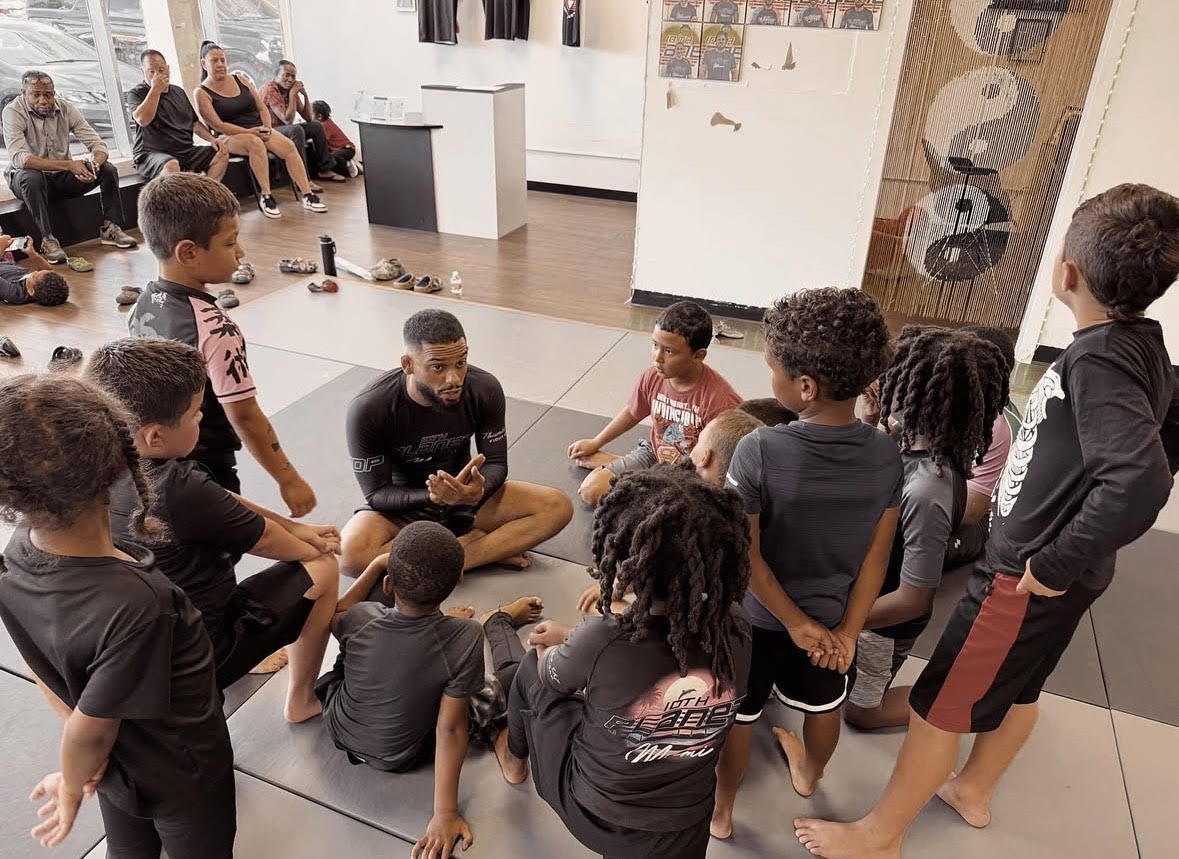
Youth Jiu-Jitsu gives kids a place to build confidence, focus, and real resilience one class at a time.
Kids grow fast, and not just physically. One week you see a shy kid hanging back at drop-off, and a few weeks later that same kid is making eye contact, speaking up, and moving with a little more certainty. We see changes like that often in Youth Jiu-Jitsu, because progress is built into the experience: learn a skill, practice it safely, improve it, and repeat.
In our gym, we keep training structured and upbeat, while still taking the work seriously. Youth Jiu-Jitsu isn’t about “toughening kids up” in a harsh way. It’s about giving your child a system for handling pressure, solving problems, and working through mistakes without melting down or shutting down.
If you’re looking for Jiu-Jitsu in Miramar, FL, you’re probably weighing two big questions: Will this help my child in real life, and will it be safe and positive? Below are five practical, research-supported ways our youth program helps kids thrive on the mats, at school, and at home.
1. Confidence That Comes From Earning It
Confidence is different when a kid earns it. In Youth Jiu-Jitsu, your child doesn’t get “hyped up” and sent on their way. We build confidence through skill acquisition, repetition, and measurable progress. When a kid learns how to escape a tough position or remembers a sequence without prompts, that success sticks.
Research lines up with what we see on the mat. Parent-reported outcomes around Brazilian Jiu-Jitsu include a 96.4% improvement in confidence, along with meaningful gains in self-discipline and emotional control. Those numbers make sense because kids can feel themselves improving, and it’s not vague. It’s specific. A technique either works better than last week or it doesn’t, and we adjust.
How we build confidence in class
We coach confidence like a skill, not a personality trait. That usually means:
- Starting with fundamentals that your child can actually execute (not complicated moves that look cool but don’t land)
- Celebrating effort and correct decision-making, not just “winning”
- Giving clear feedback that helps kids self-correct without embarrassment
- Pairing students thoughtfully so practice feels challenging but manageable
Over time, kids stop needing constant reassurance. They learn, “I can figure this out,” and that belief shows up outside training too.
2. Emotional Regulation Under Pressure
A lot of youth activities build energy. Fewer build calm. Youth Jiu-Jitsu teaches kids to notice stress in their body and respond with choices: breathe, frame, move, reset. That’s emotional regulation in a very real, physical form.
We also normalize the idea that discomfort is part of learning. Getting stuck in a position, losing balance, forgetting a step, or tapping out is not a catastrophe. It’s information. Kids learn to recover quickly and try again, instead of spiraling into frustration.
Research has shown major mental health benefits for youth who train, including an 87.5% reduction in anxiety reported in one dataset, plus improvements in resilience and grit. While every child is different, the pattern is familiar: regular training gives kids a healthy outlet and a consistent practice for staying composed.
What emotional regulation looks like on the mats
You’ll often notice small wins first:
- Your child takes a breath instead of panicking when a drill gets hard
- Your child accepts a correction without shutting down
- Your child taps when appropriate and resets without anger
- Your child learns to lose a round and still smile, then ask a question
Those are life skills. And honestly, they matter as much as any technique.
3. Stronger Bodies, Better Coordination, and Real Athleticism
Kids need movement that feels like play, but still develops athletic fundamentals. Youth Jiu-Jitsu delivers that in a full-body way: balance, posture, grip strength, hip mobility, core engagement, and coordination. And because class is dynamic, it tends to keep kids engaged better than repetitive exercise.
From a health standpoint, grappling-based training can support cardiovascular conditioning and overall fitness without requiring kids to be “good at sports” to start. The movements are varied: rolling, base-building, bridging, shrimping, standing up safely, and learning how to control another body while controlling your own.
This matters in a time when many families are working against long hours sitting at school, on devices, or in cars. Youth Jiu-Jitsu in Miramar gives your child a weekly routine that builds physical competence gradually, not all at once.
Safety is part of fitness
We keep safety central. That means controlled training, age-appropriate drills, and a strong emphasis on tapping, communication, and respect. The goal is sustainable progress, not exhaustion for its own sake.
4. Problem-Solving Skills That Transfer to School and Home
Jiu-Jitsu is often called “human chess,” and for kids, that’s a pretty accurate description. A match is basically a sequence of decisions: Where are my hands? Where are my hips? What happens if I move left instead of right? What’s the safest option here?
In class, we teach kids to think in simple, repeatable frameworks, so they can make decisions under pressure. That kind of structured problem-solving can transfer into everyday situations: finishing homework without giving up, breaking a big task into steps, or trying a new approach when the first one doesn’t work.
Research also supports these behavioral benefits. Reports include a 65% improvement in peaceful problem-solving and meaningful reductions in bullying incidents. That doesn’t mean training turns kids into saints. It means kids practice conflict management and self-control in a supervised environment, which can reduce impulsive reactions elsewhere.
A simple mindset we reinforce
We want kids to leave class with a few steady mental habits:
1. Notice what’s happening (position and pressure)
2. Pick a goal (escape, control, or improve position)
3. Try a clean technique
4. If it fails, adjust and try again
5. Ask questions and learn from the result
That’s a learning loop. Kids who adopt it tend to become more coachable in general, including at school.
5. Social Skills and Belonging That Feel Real
Youth activities are often about socializing, but not always in a healthy way. Some environments reward being the loudest or the most naturally talented. On our mats, we build a different kind of social confidence: kids learn how to be a good partner, how to listen, how to lead when it’s their turn, and how to handle small conflicts respectfully.
Because training requires cooperation, kids quickly learn that being careless, rude, or reckless doesn’t work. Progress depends on trust. Even competitive kids start to understand that if you want good rounds, you have to be a good teammate.
We also see something families appreciate a lot: face-to-face community. Research highlights how martial arts participation supports social connection, punctuality, respect, and constructive conflict handling, with strong family involvement around youth programs. That community piece is often the quiet reason kids stick with training.
What a healthy training culture teaches
In Youth Jiu-Jitsu, your child practices:
- Introducing themselves and working with different partners
- Taking turns and sharing space
- Listening to instructions and responding respectfully
- Handling wins without bragging and losses without excuses
- Showing care for training partners, even while working hard
Those are the kinds of social skills that show up at school, at family gatherings, and in group projects later on.
What Parents Should Look For in a Youth Program
If you’re exploring Youth Jiu-Jitsu in Miramar, it helps to know what “good” looks like beyond the basics. We encourage parents to pay attention to the feel of the room: Is it structured? Are kids supervised? Do coaches correct behavior quickly and calmly? Is safety treated as a skill?
Here are a few practical signs your child is in a solid learning environment:
- Classes have a clear plan, not random moves thrown together
- Coaches manage intensity so kids can train hard without chaos
- Kids are taught how to tap, how to reset, and how to communicate
- Technique is explained in simple steps, then practiced with repetition
- Respect is consistent, not optional depending on mood
When those pieces are in place, kids usually relax. And when kids relax, learning accelerates.
Take the Next Step
If you want a place where your child can build real confidence, stronger habits, and practical skills, our Youth Jiu-Jitsu program is designed to make progress feel achievable week after week. We focus on structure, safety, and coaching that meets kids where our kids actually are, not where adults assume they “should” be.
When you’re ready, we’d love to help you explore training at 10th Planet Jiu-Jitsu Miami here in Miramar, FL. Our goal is simple: give your child a positive space to grow, and give you a program you can feel good about committing to at 10th Planet Jiu-Jitsu Miami.
If you’re curious about Jiu-Jitsu training, join a free class at 10th Planet Jiu-Jitsu Miami and learn from the ground up.