
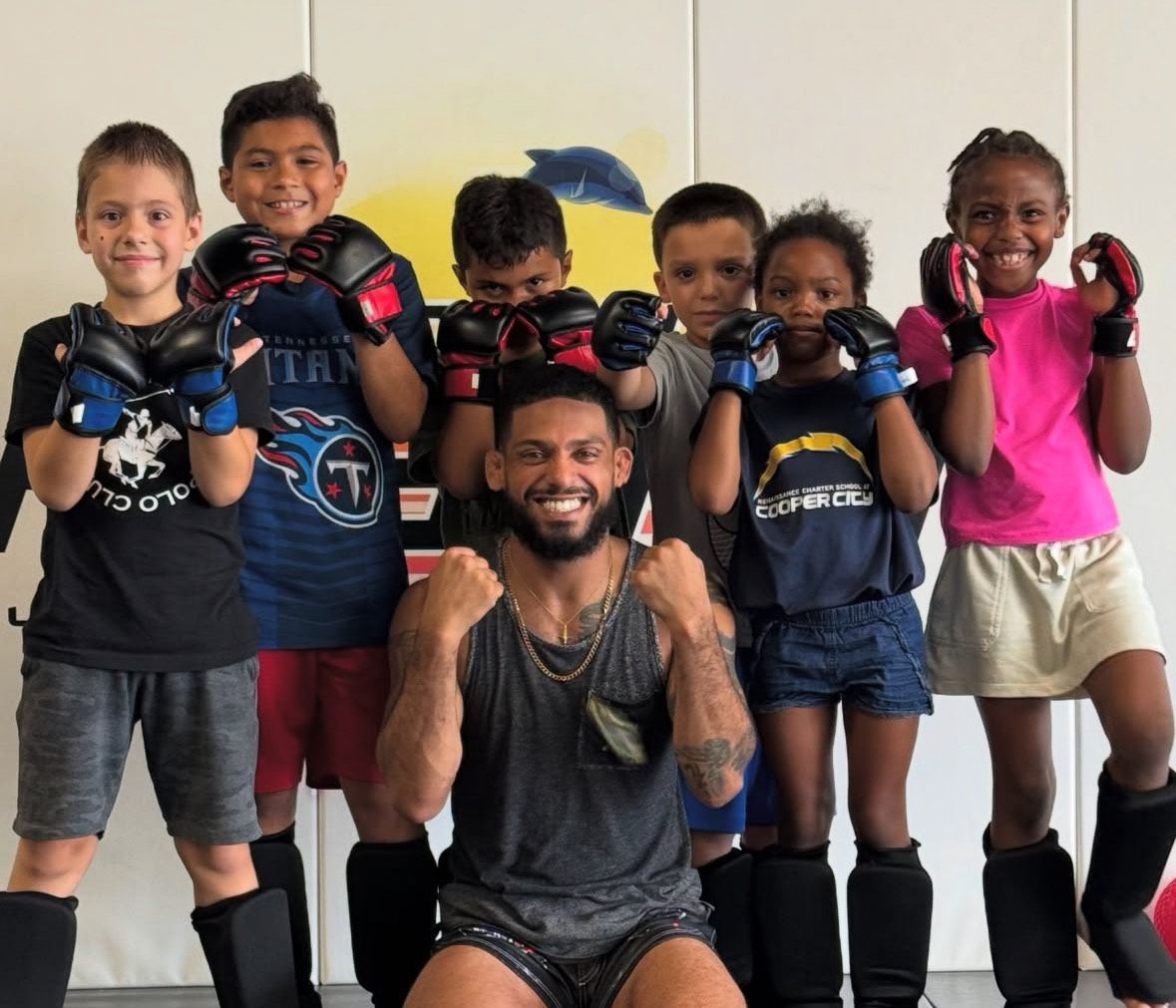
Youth Jiu-Jitsu gives kids a place to struggle safely, win small, and carry that confidence into everyday life.
Parents usually come to us for one of two reasons: confidence or healthy structure. Sometimes it starts with a simple goal like “get my child active again,” and sometimes it’s more personal, like helping your kid feel steadier in social situations. Either way, Youth Jiu-Jitsu works because it’s not just exercise or “self-defense” in the abstract. It’s a repeatable practice of problem-solving under pressure, with coaches guiding every step.
There’s a reason so many families stick with it once they try it. A 2024 EJ Sport Journal survey found 96.4 percent of parents reported improved confidence in kids who trained Brazilian Jiu-Jitsu, along with reduced anxiety at 87.5 percent and improved commitment at 92.8 percent. Those numbers make sense when you see what happens on the mats week after week: kids learn how to try, fail, adjust, and try again without spiraling.
In Miramar, where family schedules are packed and screen time can quietly take over, Jiu-Jitsu in Miramar, FL can be a practical antidote. It gives kids a physical outlet, a social circle, and a steady rhythm that rewards consistency. And because our youth program is no-gi, it feels approachable for many kids right away, especially kids who prefer movement and play to stiff, formal routines.
Why Youth Jiu-Jitsu builds real confidence (not just hype)
Confidence is not the same as being loud or fearless. The kind of confidence we care about looks like this: your child tries something hard, stays calm when it doesn’t work, and keeps going anyway. Youth Jiu-Jitsu builds that kind of confidence through structured challenge, not pep talks.
Confidence comes from measurable progress
Kids thrive when effort leads to visible improvement. In class, your child can feel progress in a very concrete way: better balance, cleaner movement, sharper timing, more control in positions that used to feel confusing. Belts and promotions matter here too, because they mark growth, but the daily wins matter more.
We also keep the learning loop tight. Kids drill a skill, test it with a partner in a controlled way, and get coaching in real time. That feedback is where confidence grows. It’s not vague praise. It’s “move your hips here,” “keep your elbows tight,” “breathe and reset.”
Confidence is also emotional control
In Youth Jiu-Jitsu, kids feel pressure in a safe environment. That sounds intense, but it’s exactly what helps. They learn to manage the moment when a position feels uncomfortable, when they’re behind, or when they need to stay patient. Over time, that becomes emotional regulation, which shows up at home and at school.
The same 2024 survey reporting confidence gains also found parent-reported improvements in mood at 92.8 percent and mental flexibility at 92.9 percent. That flexibility is a big deal in childhood. It’s the ability to switch strategies instead of melting down.
Healthy habits start early, and the mats make them stick
We don’t have to convince you that kids need movement. The harder part is finding something your child will actually do consistently. Youth Jiu-Jitsu helps because it’s engaging. Kids are thinking, moving, reacting, and laughing in between serious moments. It doesn’t feel like “workout time,” even though it absolutely is training.
A full-body activity that fights sedentary routines
Childhood obesity affects 13.7 million kids in the U.S., and it often pairs with long hours sitting and scrolling. Jiu-Jitsu in Miramar, FL gives kids a reason to get off the couch that isn’t boring. Classes build:
• Cardiovascular capacity through rounds, movement games, and continuous drilling
• Strength endurance from holding positions and controlling posture
• Coordination and balance from grappling movements and transitions
• Body awareness, which can improve posture and reduce clumsy “growing pains” moments
If your child plays other sports, this can complement that too, because better balance, stronger hips, and calmer breathing under stress transfer well to almost anything athletic.
The habit is bigger than fitness
We also see healthier routines form around training. Kids start wanting water instead of soda because class makes them thirsty. Bedtimes get easier because practice burns energy in a good way. Even homework can become smoother because training creates a predictable schedule.
That kind of structure is underrated. Confidence is great, but consistency is what keeps it growing.
Bullying, boundaries, and the quiet power of knowing what to do
One of the most common questions we hear is whether Youth Jiu-Jitsu helps with bullying. We take that seriously, especially because bullying affects about 20 percent of students ages 12 to 18 nationally, and Miramar families feel those realities in day-to-day school life too.
The goal is not to turn your child into a fighter. The goal is to help your child carry themselves differently and respond differently.
What changes when a kid trains
A child who trains often:
• Stands and moves with more purpose
• Makes eye contact more comfortably
• Sets boundaries more clearly
• Feels less “trapped” when someone invades space
Family participation trends in martial arts are also telling: studies show family involvement can reduce bullying by around 50 percent while improving discipline and peaceful problem-solving. When kids know their parents value the same standards, confidence becomes a household culture, not just a class activity.
Self-defense in Youth Jiu-Jitsu is mainly about control
Jiu-Jitsu is built around leverage and positional control, which means kids learn how to escape, how to get safe, and how to hold someone without relying on strikes. That matters for safety and for maturity. We emphasize decision-making: when to disengage, when to ask for help, and how to stay calm.
Is BJJ safe for kids? How we keep training smart
Safety is a fair concern, and we treat it as part of the curriculum. Youth Brazilian Jiu-Jitsu is ground-based, which generally means fewer high-impact collisions than many contact sports. But safe training still requires the right environment and coaching, so we build our youth classes around clear rules and supervision.
What our safety culture looks like day to day
We keep class structured and age-appropriate. That includes partner matching, controlled intensity, and constant coaching on how to move without panic. We also teach kids to communicate, because “tap early” is a skill, not just a phrase.
Here’s what we prioritize in every Youth Jiu-Jitsu class:
• Controlled drilling before live sparring so kids understand the movement first
• Size and experience awareness when pairing partners
• Clear boundaries around intensity, with coaches stopping rounds quickly if needed
• Emphasis on tapping, resetting, and protecting training partners
• A calm atmosphere where kids can ask questions without feeling embarrassed
That last point matters more than most parents expect. When kids feel safe socially, they take healthy risks physically, and that’s where growth happens.
Why no-gi training helps kids adapt and think creatively
No-gi training changes how kids grip, move, and solve problems. Without relying on cloth grips, your child learns to control with positioning, timing, and smart pressure. It becomes a bit more like a moving puzzle than a static hold.
That’s also why Youth Jiu-Jitsu can support cognitive development. Kids make quick decisions, test solutions, and adjust on the fly. Recent research trends from 2022 to 2024 highlight gains in resilience and focus for kids training martial arts a couple times per week, with many reporting improvements in attention and mental toughness. We see that in class as kids learn to stay present instead of zoning out when something gets difficult.
What your child learns in the first few months
Parents often want a timeline, not a promise. That’s reasonable. While every child is different, we usually see a predictable pattern when kids train consistently.
Early wins look like movement, manners, and momentum
In the first few weeks, your child learns how to be in class: lining up, listening, partnering, and following directions. This is not glamorous, but it’s powerful. Many parents notice better behavior at home simply because kids practice self-control in a structured environment.
Then the physical learning starts stacking. Escapes, base, posture, and balance become more natural. Your child starts recognizing positions instead of just reacting emotionally. That’s when confidence starts to feel “real,” because it’s rooted in skill.
A simple progression you can expect
If you want a clean way to picture progress, here’s the general pathway we see:
1. Comfort on the mats, including learning how to move safely and stay calm
2. Basic positional awareness, like understanding top, bottom, and safe posture
3. Reliable escapes and reversals that help kids feel less stuck
4. Controlled sparring where your child can try techniques with guidance
5. Better composure in everyday life, including school focus and conflict management
Parent reports often match this arc. The 2024 EJ Sport Journal survey also noted improved concentration and school-related focus for many kids, which makes sense when training becomes a practice of attention under pressure.
Youth Jiu-Jitsu in Miramar: building community for kids and families
Miramar is full of growing families, and that means kids need more than activities. Kids need belonging. A good youth program creates positive peer pressure: the kind where kids want to show up because their teammates notice their effort.
We also see something special when families train or support training together. Studies show high rates of family participation in martial arts, and that can strengthen bonds while reinforcing discipline at home. Even if you’re not training yourself, simply sharing the routine, the language of effort, and the celebration of small improvements can change how your child sees challenges.
And in a time when so much social life happens through screens, having a place where kids interact face-to-face, solve problems with real people, and learn respectful physical contact is honestly refreshing.
Take the Next Step
If you want Youth Jiu-Jitsu that builds confidence without turning everything into pressure, our program is designed to meet your child where your child is right now, then build from there. We focus on safe training, steady structure, and the kind of skill development that naturally creates better habits over time.
When you’re ready, we’d love to help your family experience what makes youth training feel both serious and fun at 10th Planet Jiu-Jitsu Miami, right here in Miramar. You can start small, stay consistent, and watch the changes add up faster than you might expect.
Improve your fitness, confidence, and grappling ability by joining a free Jiu-Jitsu class at 10th Planet Jiu-Jitsu Miami.