
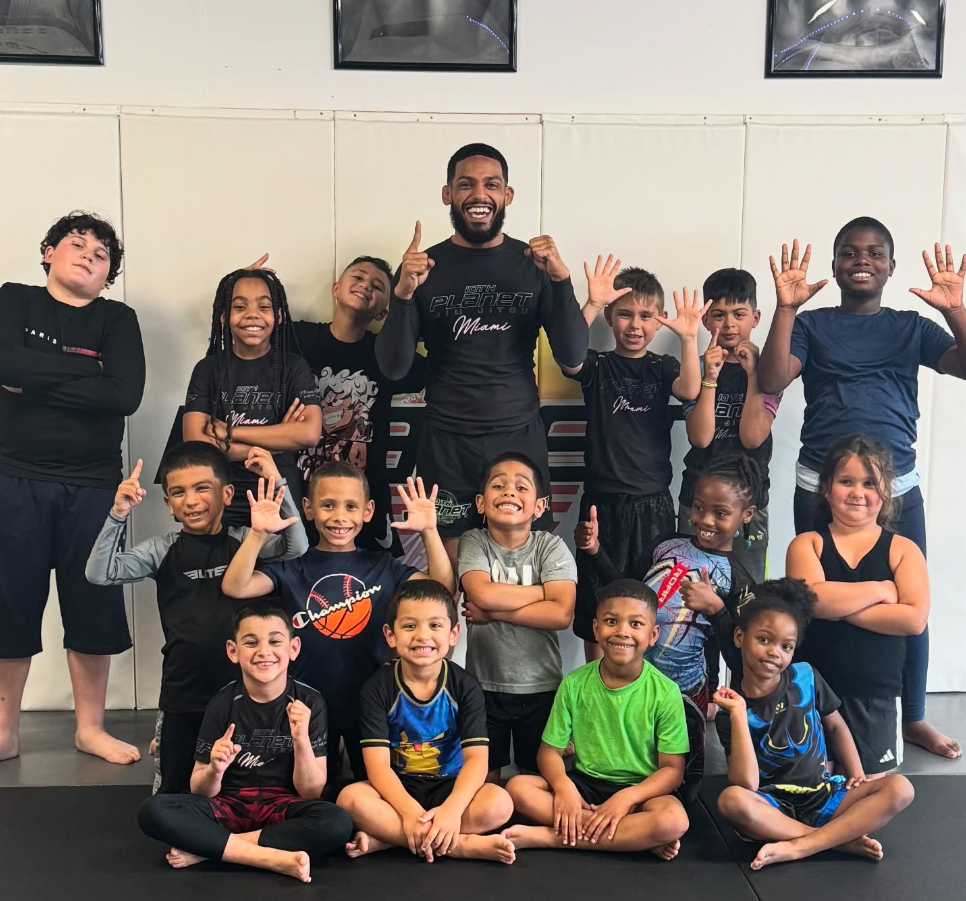
Youth Jiu-Jitsu turns after-school energy into confidence, coordination, and calmer decision-making.
If you are searching for Youth Jiu-Jitsu in Miramar, you are probably looking for more than a place where your child can “burn energy.” Most parents want a program that improves fitness, yes, but also helps kids listen, problem-solve, handle frustration, and feel comfortable in their own skin.
Youth sports are a big part of life for American families right now. In 2023 to 2024, 56.7 percent of U.S. children ages 6 to 17, nearly 28 million kids, participated in a sports team or lessons outside school. In that same national snapshot, kids in sports were slightly more likely to hit the daily physical activity guideline of 60 minutes, 21.7 percent versus 17.0 percent. The same report also found lower reported rates of current anxiety and depression diagnoses among participants, an association rather than proof that sports alone create mental-health outcomes, but still a meaningful signal that structured activity matters.
Our Youth Jiu-Jitsu program is built around that idea: give kids a consistent routine where movement, confidence, and respectful boundaries grow together, one class at a time.
What Youth Jiu-Jitsu is, and what it is not
Youth Jiu-Jitsu is grappling-based martial arts training. Instead of focusing on strikes, we teach children how to move their body with control, manage distance, use leverage, and understand positions. The training is physical, but it is also thoughtful. Kids learn by doing, making small adjustments, and trying again.
It is also important to say what it is not. Youth Jiu-Jitsu is not a fight club, and it is not a “toughen them up” bootcamp. We do not treat intensity as a shortcut. We treat it as something a child earns through maturity, skill, and trust.
In practical terms, your child learns how to be a good training partner before learning advanced techniques. That sounds simple, but it is the foundation for everything else.
Physical benefits: full-body movement that actually carries over
Grappling develops a kind of athleticism that is hard to copy with machines or one-direction drills. Kids crawl, bridge, rotate, balance, grip, and stabilize. Over time, that becomes stronger posture, better coordination, and more confidence in everyday movement.
Coordination, mobility, and balance
Youth Jiu-Jitsu asks children to use both sides of the body, change levels, and keep balance while someone else is moving too. That is why you will see improved footwork, fewer “clumsy moments,” and better overall body awareness. A lot of kids start out stiff or awkward, and then a few weeks later they move more freely without even noticing the change.
We also prioritize mobility as a skill, not just stretching for the sake of it. When hips and shoulders move better, techniques feel smoother and kids rely less on brute force.
Strength and conditioning without mindless grinding
Jiu-jitsu builds functional strength in the legs, hips, back, and core because kids are constantly stabilizing and changing angles. At the same time, we keep conditioning age-appropriate. We would rather have your child leave class feeling challenged and proud than exhausted and discouraged.
This is a key reason Jiu-Jitsu in Miramar, FL works for many families with busy school-year schedules. It is a workout, but it is also skill-building, which keeps kids engaged longer than repetitive drills.
Mental benefits: focus, problem-solving, and emotional regulation
Youth Jiu-Jitsu is sometimes described as “physical chess,” but for kids it can feel more like learning to solve puzzles while their heart rate goes up. A child tries a movement, meets resistance, and has to adapt. That process develops focus in a way that lectures cannot.
Decision-making under pressure
In class, kids learn to recognize positions, understand what is safe, and choose a response. If the first idea does not work, we guide them to try a second option. That teaches flexible thinking.
This is also where confidence comes from. Confidence is not hype. It is the quiet feeling of “I have done hard things before, I can do this too.”
Handling frustration and learning to reset
Emotional regulation is a real training outcome when a program is run well. Children learn that frustration is normal, setbacks happen, and tapping is allowed. They also learn how to breathe, listen, and keep their hands calm even when they want to scramble.
We treat the tap, or a verbal stop, as a smart choice. It is a safety tool and a communication skill. When kids understand that, they start to trust the process more, and class becomes a place where mistakes are part of learning, not something to hide.
Social benefits: communication, cooperation, and healthy confidence
Youth Jiu-Jitsu is not a team sport in the traditional sense, but it still builds community. Kids work with partners, rotate, and learn how to be respectful even when they are competitive. That balance is valuable.
Learning to work with different personalities
In a typical class, your child will partner with kids who are bigger, smaller, faster, or brand new. We coach partner behavior constantly: waiting turns, using appropriate intensity, listening, and speaking up when something feels uncomfortable.
That kind of guided interaction can be especially helpful for kids who are shy, new to the area, or just unsure socially. It gives them a script to follow: greet your partner, drill responsibly, and be a good teammate.
Bullying awareness without unrealistic promises
Parents often ask if Youth Jiu-Jitsu can help with bullying. Training may improve posture, confidence, and boundary-setting. It can also teach kids to stay calmer when someone tries to provoke them. But we are careful not to promise that martial arts “solves bullying.”
Our approach emphasizes judgment first: avoid escalation, create space, and get an adult involved. Self-defense is as much about awareness and decisions as it is about technique.
Safety standards you should expect in a youth program
No contact sport is risk-free, and we do not pretend otherwise. Safety comes from systems: coaching, partner selection, progressive training, and good communication. A 2025 survey of 360 Italian BJJ athletes reported that 92 percent had experienced at least one injury, with knees most frequently affected and most injuries occurring during training. That sample was not limited to children and does not represent U.S. youth programs, but it reinforces a simple point: safety needs to be built into everyday habits.
Here is the safety checklist we follow and encourage you to look for during any trial class in our Youth Jiu-Jitsu in Miramar program:
• Clear stop rules, including tapping and verbal cues, reinforced every class so kids never feel stuck
• Age and experience appropriate training progressions, so beginners are not thrown into advanced live rounds
• Partner matching based on size, experience, and temperament, not age alone
• Active supervision during drilling and sparring, with coaches close enough to correct unsafe behavior immediately
• Hygiene expectations, including clean uniforms, trimmed nails, no jewelry, and guidance on covering skin issues
• Injury communication procedures, where kids are encouraged to speak up early and parents are informed promptly
If you watch from the sidelines, you should see coaches moving, scanning, and stepping in quickly. You should also hear coaching language that is calm and specific, not aggressive or shaming.
How classes differ by age and experience
Developmentally appropriate training is not a buzzword. It is the difference between a kid loving the sport for years and a kid burning out in a month.
Younger children: movement skills and simple rules
For our youngest students, we emphasize movement games, balance, coordination, and listening skills. We keep techniques simple and repeatable. Safety rules are taught like a routine: stop means stop, tap means release, and we respect partners.
Kids at this age learn best through structure with a bit of play built in. When that structure is consistent, confidence grows fast.
Elementary age: foundations, escapes, and problem-solving
As attention span and body control improve, we add more positional awareness and structured partner drills. We teach basic escapes, safe top control concepts, and how to stay calm in a tight spot.
This is also where kids start to feel the “puzzle” aspect of Youth Jiu-Jitsu. Instead of memorizing, they begin to understand why a movement works.
Preteens and teens: technical growth and optional competition prep
Older students can handle more detail, more conditioning, and more responsibility with partners. We introduce positional sparring that teaches timing without turning every round into a chaotic scramble.
Competition is optional. Long-term development matters more than early medals, and research discussions in 2025 have raised concerns about early specialization and long-term athletic development in youth jiu-jitsu competition structures. Our goal is to keep progress sustainable so teens can train for years, not just for a single season.
A practical first 30 days guide for new students
Starting something new is exciting, but it can also feel a little awkward, for kids and parents. Here is what the first month usually looks like when you join our Youth Jiu-Jitsu in Miramar community:
1. Week one: learning class routines, basic movements, and the safety language around tapping and control
2. Week two: adding simple partner drills, like escapes and positional holding, with lots of coaching feedback
3. Week three: improving timing and balance, and starting light positional sparring when readiness is clear
4. Week four: building consistency, understanding a few “go-to” options, and feeling more comfortable with new partners
5. End of month: discussing next steps, whether that means staying recreational, adding a second class, or setting a small goal
Most kids also go through a normal confidence curve. The first class might feel overwhelming, then suddenly a technique clicks and the smile says it all.
Questions Miramar families should ask before enrolling
Parents deserve clear answers, especially for a contact sport. When you look at the class schedule and consider joining, keep these questions in mind.
Is my child required to compete?
No. We support both recreational training and competition goals, and we never treat tournaments as mandatory for progress. Kids can learn, rank up, and feel successful without stepping on a competition mat.
How often should my child train?
Most families start with one or two classes per week. That is enough to learn patterns without overloading school, sleep, and recovery. If your child is thriving, we can help you choose a realistic next step based on energy levels and interest.
What should my child wear to the first class?
For a first session, athletic clothing that allows movement is usually fine, as long as it is clean and fitted enough to be safe. We will guide you on when to add items like a rash guard or grappling shorts. We also ask for trimmed nails, no jewelry, and basic hygiene, since close contact makes cleanliness a real part of safety.
What you can expect when you visit and watch a class
When you walk in, you should feel that the room is organized. Class generally includes a warmup with purposeful movement, a technical section where we teach and drill, and a controlled training portion where kids apply skills with supervision.
You will also notice how we measure progress. We look for calm decision-making, respect for partners, and technical improvement. That is why Youth Jiu-Jitsu works so well for many kids who do not love traditional team sports. Progress is personal, and each child can build momentum without needing to “make the team.”
Take the Next Step
If you want a youth program that blends athletic development with real character skills, our approach at 10th Planet Jiu-Jitsu Miami is built for that balance. We focus on safe training habits, age-appropriate coaching, and a culture where kids learn to work hard without losing control or kindness.
Whether your child is brand new to martial arts or simply ready for a more engaging way to stay active, we would love to help you explore what Youth Jiu-Jitsu can look like week to week here in Miramar. You can start with one class, get a feel for the environment, and build from there at a pace that makes sense.
Experience the training environment at 10th Planet Jiu-Jitsu Miami by joining a class today.