
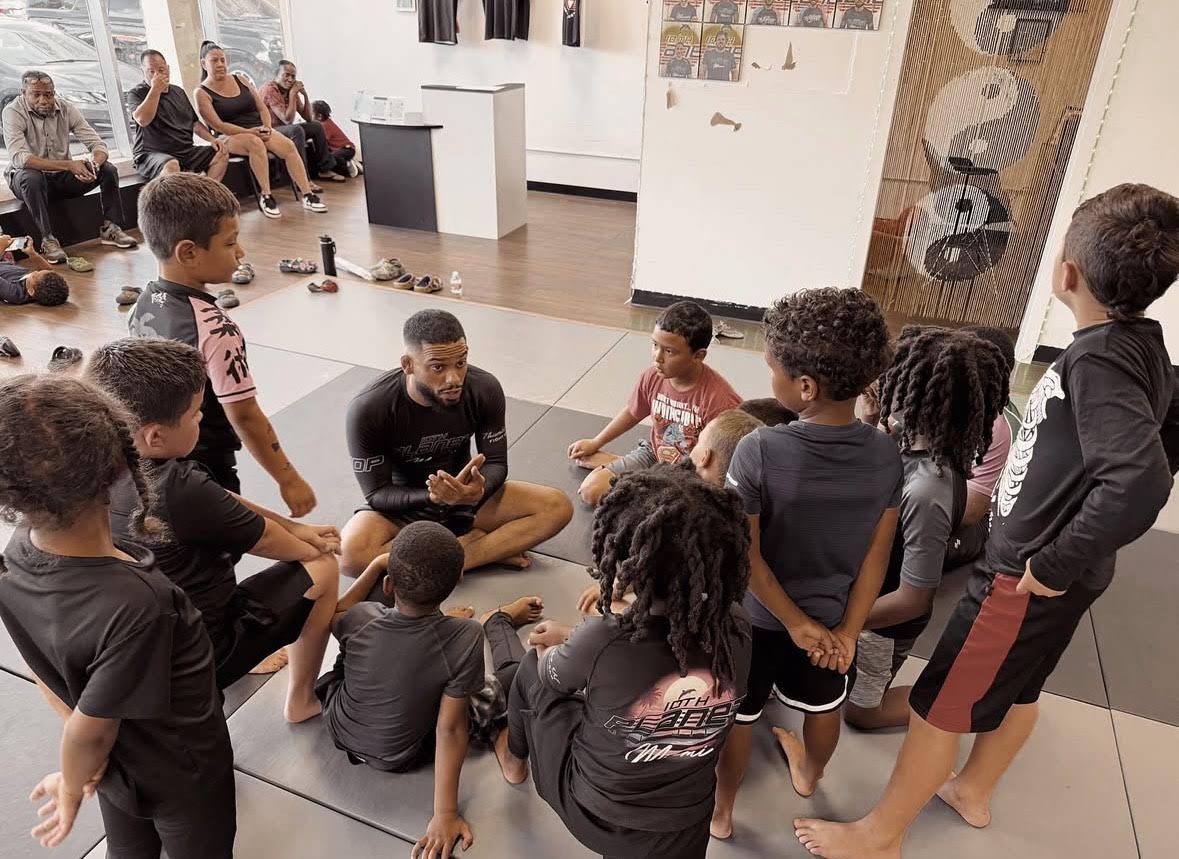
Youth Jiu-Jitsu gives kids a place to practice focus and cooperation, not just learn moves.
Miramar parents usually start with practical questions: Is this safe, will my child fit in, and what happens after the first week when the novelty wears off? We get it, because Youth Jiu-Jitsu only helps when it becomes a steady routine your child can stick with and grow inside.
In our kids program, the goal is not to turn every student into a competitor. The goal is to give your child a structured environment where listening, self-control, and respectful partner work are required every single class. Over time, those habits can show up at home, in school, and in how your child handles frustration.
Youth Jiu-Jitsu in Miramar works especially well for families who want an indoor, consistent activity that does not depend on the weather, the season, or making a travel team. Kids show up, line up, train with partners, and leave with a clear sense of what they improved on that day.
Why Miramar families are choosing Youth Jiu-Jitsu now
A lot of kids are busy, but not always in a way that builds them. Youth programs can become either chaotic or overly intense, and neither is ideal for long-term growth. What many families want is a middle ground: a place where kids are active, challenged, and coached with clear boundaries.
Research is also starting to reflect what parents have noticed for years. A 2024 clinical review reports that youth martial-arts participation can support physical fitness, mindfulness, stress reduction, and self-control, while also warning that injury risk increases when training is poorly supervised or overly competitive. A 2025 systematic review of 16 randomized controlled trials found that martial-arts interventions improved children’s prosocial behavior and reduced aggression, with stronger effects in programs that ran roughly 12 to 16 weeks and included consistent weekly attendance. That does not mean every child changes overnight, but it supports a realistic timeline: think months of steady practice, not a miracle after two classes.
For families searching for Jiu-Jitsu in Miramar, FL, we like to frame the decision simply: you are not only picking an activity, you are picking an environment. The environment is what shapes discipline and teamwork.
What kids actually learn in a typical class
From the outside, jiu-jitsu can look like wrestling. From the inside, a well-run youth class is closer to a guided lab where kids practice movement, decision-making, and communication with a coach steering the room.
Structure matters more than hype
We run classes with a predictable rhythm, because kids do better when they know what is coming next. That rhythm also creates natural moments for discipline: lining up, listening, waiting for a turn, and following safety rules even when energy is high.
A typical session includes warm-ups, skill instruction, partner drills, and age-appropriate live training when students are ready. Every part of that sequence teaches something different. Warm-ups train body awareness and effort. Technique work trains attention and memory. Partner drills train cooperation. Live rounds train composure under pressure.
The “small wins” are the point
In Youth Jiu-Jitsu, progress often looks like small upgrades: remembering a grip, turning the right direction, staying calm when pinned, or tapping early instead of panicking. Those are not flashy milestones, but they are real. They also create a healthy lesson about delayed gratification: improvement is earned, not handed out.
How partner training builds teamwork without needing a scoreboard
Teamwork is not only about wearing the same jersey. In jiu-jitsu, teamwork shows up through partner responsibility. Your child cannot train well alone. A partner is required, and that partner’s safety matters.
Partner-based training gives kids repeated chances to practice:
- Taking turns drilling and letting a partner learn, not rushing to “win” the rep
- Communicating clearly, like saying “too tight” or “can we reset,” instead of melting down
- Adjusting intensity so the round is productive for both kids, not just one
- Respecting boundaries, including tapping and stopping immediately
- Learning to be a good teammate even when paired with someone new
This is one reason Youth Jiu-Jitsu in Miramar can click for kids who do not love traditional team sports. There is still community and cooperation, but there is also personal pacing. Your child can improve without being benched, cut, or stuck in a role that never changes.
How repetition and setbacks build real discipline
Discipline is not a personality trait kids either have or do not have. It is a skill built through repetition, feedback, and consistency. In our experience, Youth Jiu-Jitsu creates discipline because it quietly demands it.
Where discipline shows up on the mat
We see discipline developing in a few predictable ways:
1. Consistent attendance
Kids learn that missing weeks at a time makes everything harder. Showing up regularly makes everything easier.
2. Following instructions
Warm-ups, partner rotations, and safety guidelines all require attention. Kids practice listening even when they would rather talk.
3. Managing frustration
A child may fail an escape ten times before it works once. Learning to breathe, reset, and try again is discipline in real time.
4. Goal-setting without pressure
Instead of chasing only competition results, kids can work toward practical goals like “hold posture,” “frame correctly,” or “remember the sequence.”
5. Accountability and respect
Kids are responsible for basic readiness: arriving on time, keeping nails trimmed, bringing the right gear, and treating training partners well.
That last point matters. Discipline without respect can turn into aggression. We want the opposite: self-control plus empathy.
What research says about youth martial arts and behavior
Parents deserve honest, evidence-based language. We avoid promising that Youth Jiu-Jitsu automatically fixes behavior, guarantees confidence, or eliminates stress. Outcomes depend on coaching quality, your child’s temperament, and what happens outside the gym, too.
Here is what current research suggests, in plain terms:
• Benefits are possible and common in well-structured programs. Reviews note improvements in physical fitness, mindfulness, stress reduction, and self-control.
• Positive social outcomes are tied to how the program is taught. Research emphasizes that the instructor is a major factor in whether children experience positive outcomes, especially when ethics, self-regulation, and respect are part of instruction.
• Prosocial behavior can improve with consistent participation. The 2025 review of randomized controlled trials found improved prosocial behavior and reduced aggression, with stronger effects in programs lasting about 12 to 16 weeks with steady weekly training.
• Physical activity is a real advantage. Martial-arts training can build strength, endurance, flexibility, coordination, balance, and motor skills, and it can help kids work toward the World Health Organization recommendation of 60 minutes of moderate-to-vigorous activity daily.
There is also emerging research specific to Brazilian jiu-jitsu. A 2025 study in one Phoenix gym reported that participants and parents described a strong sense of community and felt the lessons carried into daily life. Because that study was limited to one location and a mixed group of adults and parents, we treat it as promising rather than definitive. Still, the idea makes sense: a partner-based practice that requires calm communication can transfer into real conversations at school and at home.
Safety standards you should expect in Youth Jiu-Jitsu
Jiu-jitsu is a contact sport. That is not a problem, but it does mean safety has to be intentional. The same 2024 review that highlights benefits also warns that injury risk increases when training is poorly supervised or overly competitive. We take that seriously.
How we keep training age-appropriate and controlled
When you are evaluating Youth Jiu-Jitsu in Miramar, look for practical safeguards, not vague reassurances. Our approach includes:
• Active supervision, with coaches watching partner work and stepping in early
• Clear tap-out rules, plus teaching kids to stop immediately when a partner taps
• Thoughtful partner matching by size, age, and experience whenever possible
• A gradual path to live training, so kids earn intensity through control and understanding
• Hygiene expectations that support clean mats and safe training habits
• A no-pressure stance on competition, so growth is not tied to trophies
In plain language: we want kids to train hard enough to learn, but controlled enough to stay safe. If your child has a medical concern, past injuries, or sensory issues, we encourage you to communicate with us so we can help you make good decisions.
What your child’s first class usually feels like
The first day matters. Kids walk in with different energy. Some are excited and bouncing off the walls. Some are quiet and careful, watching everything. Both are normal.
We keep introductions simple. We show new students where to line up, how to listen for cues, and how partner drills work. We also explain tapping early, because that single habit prevents a lot of problems later.
Your child will likely do basic movement patterns, a beginner-friendly technique, and controlled partner practice. If live training happens, it should be light and guided, not a free-for-all. After class, you should be able to ask what we worked on and what your child can practice next time. Progress feels better when it is specific.
Measuring progress at home without turning it into pressure
Parents often ask how to tell if Youth Jiu-Jitsu is working. You do not need to turn your home into a grading system, but it helps to watch for quiet changes. Over a few months, many families notice improvements in how kids respond to challenge, correction, and uncomfortable moments.
Here are practical signs you can track without adding pressure:
- Your child recovers faster after frustration, like losing a game or getting corrected
- Your child speaks more respectfully during disagreements
- Your child follows routines more consistently, such as getting ready on time
- Your child shows better body awareness, like balance, coordination, and calmer movement
- Your child talks about partners as teammates, not opponents
Those are the kinds of changes that tend to last, because they are built through repeated reps and real interactions, not motivational speeches.
Frequently asked questions from Miramar parents
What age can a child start?
It depends on readiness and attention span, not just age. We group kids by developmental stage and skill level, and our beginner sessions focus on movement, listening, cooperation, and safety first.
Does my child need to be athletic?
No. Youth Jiu-Jitsu is scalable. Kids build fitness through training, and we adjust expectations so beginners can succeed early without being overwhelmed.
Will jiu-jitsu make my child more aggressive?
Research does not support the idea that martial arts automatically increase aggression. Well-designed programs have been linked with improved prosocial behavior and reduced aggression, especially when respect and self-regulation are emphasized.
Is competition required?
No. We support kids who want to compete, and we also support kids who want a recreational path focused on skill, fitness, confidence, and community.
How often should kids attend?
Consistency matters more than extremes. If your schedule allows steady weekly training for a few months, that is a realistic window to evaluate changes in skill, confidence, and behavior.
Take the Next Step
Building discipline and teamwork is not about finding a magic activity, it is about finding a structured place where your child can practice those skills every week with good coaching and clear expectations. That is exactly what we work to provide through our Youth Jiu-Jitsu program in Miramar.
When you are ready, 10th Planet Jiu-Jitsu Miami can help you map out a starting point that fits your child’s age, temperament, and goals, whether your focus is confidence, self-control, or simply a healthier routine that sticks.
Train with experienced instructors and a supportive community at 10th Planet Jiu-Jitsu Miami.