
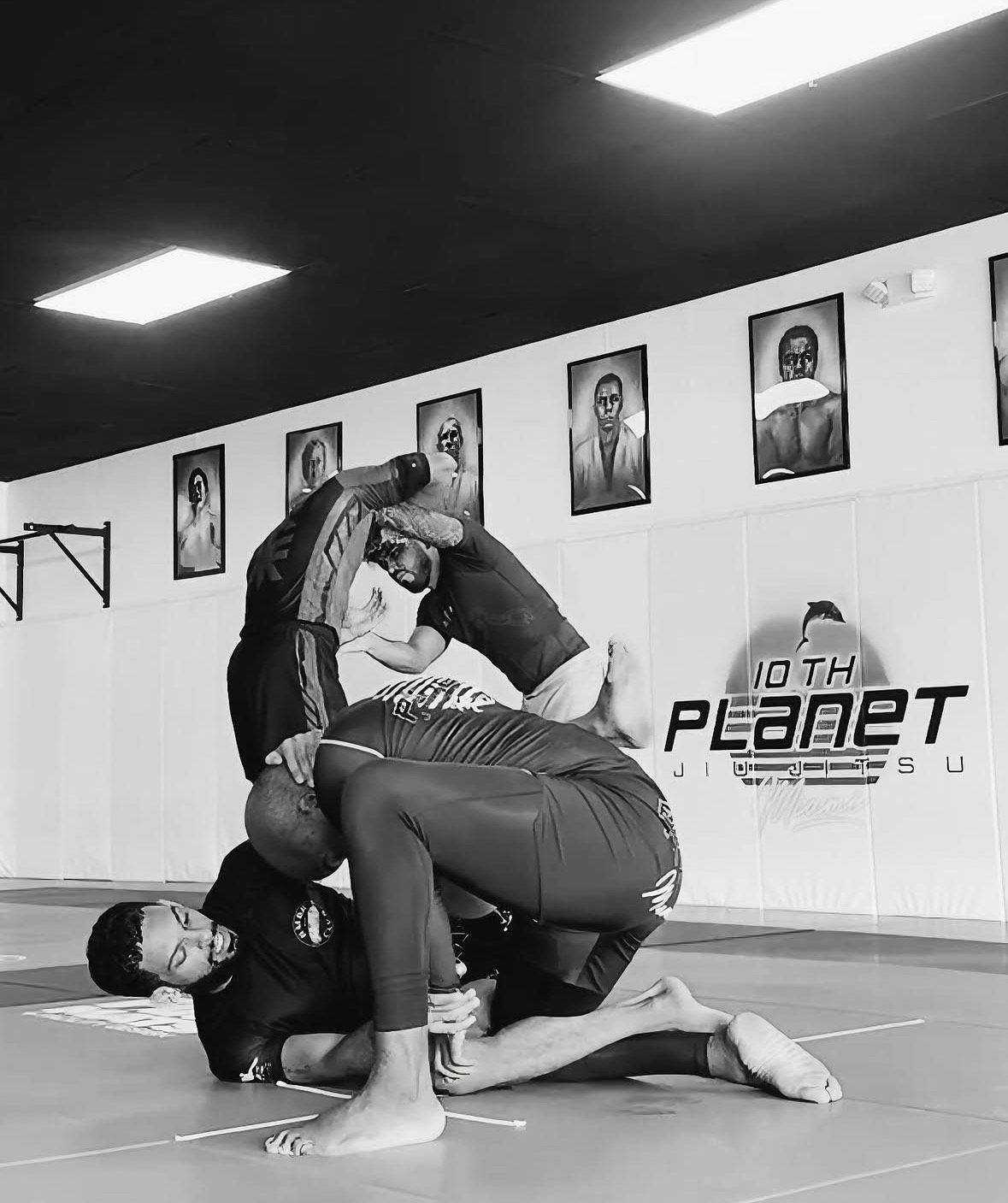
If you want a workout that teaches real skill fast, Jiu-Jitsu gives you a clear path from day one.
Starting something new as an adult can feel like a lot, especially when it looks technical or physical. The good news is Jiu-Jitsu is designed for progress, not perfection, and we coach beginners in a way that makes the first week feel doable and the first month feel like a real shift.
Miramar is full of working adults balancing busy schedules, family responsibilities, and the stress that piles up in the background. With a large 18 to 64 population, adult training is not a niche here, it is the norm. Our classes are built for real life: you come in after work, learn a few things that actually work, sweat a bit, and leave feeling more grounded than when you walked in.
This guide breaks down how beginner training works, what you will learn first, how to stay safe, and how to build strength, focus, and confidence quickly without burning out.
Why Jiu-Jitsu clicks with Miramar adults
Jiu-Jitsu is one of the rare fitness activities where your effort turns into a usable skill. You are not just doing reps for the sake of reps. You are learning how to move your body, how to stay calm under pressure, and how to solve problems while tired.
For many Miramar beginners, the first “win” is not flashy. It is simple stuff: breathing better during hard rounds, getting off your back, or realizing you can handle discomfort without panicking. Those early moments build confidence fast because they show up outside the gym too, at work, in traffic, in a tough conversation, wherever your stress usually spikes.
And because Miramar is a diverse city with a wide range of backgrounds and fitness levels, our approach stays welcoming and practical. You do not need a sports history. You do not need to be “built for fighting.” You just need a willingness to learn.
No-gi vs gi: what beginners should know before the first class
A lot of people overthink this part, so we keep it simple.
What “no-gi” feels like
No-gi training is Jiu-Jitsu without the traditional uniform and grips. You will usually wear a rash guard and shorts or leggings. The pace tends to feel more athletic because grips are different, movement is more fluid, and scrambling happens more often.
Modern Jiu-Jitsu has leaned heavily into no-gi, with more wrestling-style entries, body-lock passing, and leg-lock awareness becoming mainstream knowledge. Beginners do not need to dive into all of that immediately, but it helps to know what you are stepping into: a style that is technical, fast, and very methodical once you learn the structure.
What “gi” changes
In gi training, cloth grips slow things down and add a different layer of control. Some people love that chess-match pace. Others prefer the simpler gear and more direct feel of no-gi. Either way, the fundamentals overlap, and our job is to teach you the mechanics that make your Jiu-Jitsu work.
If you are a beginner, the right choice is the format you will actually show up for consistently. Consistency beats the “perfect” choice every time.
What you will learn first (and why it works)
Beginner progress in Jiu-Jitsu is not random. We start with positions and concepts that keep you safe and give you quick, measurable improvement.
The core beginner focus areas
- Escapes and defense so you can breathe, frame, and get out of bad spots without muscling
- Positional control so you understand where the fight is “won” before submissions even matter
- Basic submissions so you learn finishing mechanics, but also when not to force them
- Takedown and stand-up basics so you are not lost when things start from the feet
- Smart movement habits like base, posture, and pressure so you do not feel off-balance all the time
You will hear us repeat simple ideas often. That is not because we think you are slow. It is because repetition is how your nervous system learns under pressure. The goal is calm, reliable execution, not memorizing a hundred techniques.
Strength, focus, and confidence: how you build them fast
People usually come in for one reason, fitness, self-defense, stress relief, confidence, but Jiu-Jitsu tends to deliver a bundle of benefits at once.
Strength that actually transfers
You will build grip and pulling strength, hip strength, and core stability, but also “connection strength,” meaning your body learns to apply force in coordinated ways. It is the difference between being strong in the gym and being strong when you have to move another human being.
Focus under pressure
Rolling is one of the clearest focus drills you can do. You have a problem in front of you, right now, and you either solve it or you tap and reset. There is no multitasking. Over time, that kind of focused attention becomes a habit.
Confidence you can feel
Confidence in Jiu-Jitsu is not a pep talk. It is evidence. You handle a tough round. You escape a position that used to crush you. You stay composed. That changes how you carry yourself, and it tends to happen faster than most people expect.
What to expect in your first 30 days
We like to lay this out clearly because the unknown is what makes beginners nervous, not the training itself.
1. Week 1: You learn the room, the pacing, and basic safety rules, and you start building a few go-to escapes.
2. Week 2: You begin connecting positions, like how guard leads to sweeps or how top control leads to pressure and passes.
3. Week 3: Rolling feels less chaotic because you recognize patterns, even if you are still getting caught sometimes.
4. Week 4: Your conditioning improves, your movement gets cleaner, and you can usually name what went wrong instead of feeling lost.
If you are consistent, you will almost always notice better cardio and coordination within that first month. It is not magic. It is the combination of skill practice plus real-time problem solving that forces adaptation.
How often should adults train per week?
For most Miramar beginners, the sweet spot is two to three classes per week. That is enough frequency to retain what you learn and build momentum, while still recovering and handling real life.
If you train once a week, you can still improve, but it often feels like restarting every session. If you jump to five days a week immediately, some people do fine, but many get sore, sleep-deprived, or mentally fried. Sustainable progress is the goal.
A simple rule we use is this: train enough that you are excited to come back, not dreading it.
Safety for beginners: how we keep training sustainable
Jiu-Jitsu is a contact sport, so honesty matters. You can get bumps and bruises. But you can also train for years safely if you do the basics right.
We coach beginners to:
- Tap early and without ego, especially when a joint is controlled
- Move with intention instead of yanking or exploding out of positions
- Communicate injuries, soreness, and boundaries before class starts
- Choose controlled partners and prioritize learning over winning rounds
- Treat recovery like part of training, including sleep, hydration, and mobility work
We also structure training so you are not thrown into chaos on day one. You build skill in layers, and that makes everything safer and more enjoyable.
Is Jiu-Jitsu effective for self-defense?
Yes, especially when it is trained with realistic control, position-first thinking, and the ability to stay calm when things get messy. Jiu-Jitsu teaches you how to manage distance, clinch safely, control someone on the ground, and escape bad positions.
For beginners, the self-defense value shows up quickly in a few ways: you get comfortable with contact, you learn how to protect yourself when pinned, and you stop freezing when pressure hits. That is a big deal.
And to be clear, self-defense is not about looking for trouble. It is about feeling capable if something happens.
What to wear and bring to your first class
Keep it simple. If you are training no-gi, wear athletic gear that stays in place. Bring water. Show up a little early so we can point you in the right direction and answer questions without rushing.
If you are not sure what is appropriate, check the website before you arrive. The class schedule page and program details usually clarify what you need, and if you still have questions, we will help you sort it out.
Adult Jiu-Jitsu in Miramar, FL: a program built around real schedules
Miramar has steady household incomes, a strong working-age base, and plenty of adults who want training that fits between meetings, commuting, and family time. That is exactly why we keep our Adult Jiu-Jitsu in Miramar, FL approach practical.
We organize training so you can progress even if you cannot train every day. You will learn fundamentals that hold up in real sparring, not just techniques that look good in a demo. And because no-gi Jiu-Jitsu continues evolving with more wrestling integration and leg-lock systems, we keep your fundamentals modern, without overwhelming you.
If your goal is Jiu-Jitsu in Miramar, FL that feels structured, challenging, and beginner-friendly, our curriculum is designed to meet you where you are and push you forward at a smart pace.
Take the Next Step
Building skill in Jiu-Jitsu is one of the most rewarding things you can do for your body and mindset, and you do not need a perfect starting point. You need a plan, a consistent schedule, and coaching that keeps you safe while you improve.
That is exactly what we focus on at 10th Planet Jiu-Jitsu Miami. If you are in Miramar and you want training that builds strength, focus, and confidence fast, we would love to help you get your first week handled and your first month rolling with momentum.
Improve your timing, movement, and grappling fundamentals by joining a Jiu-Jitsu class at 10th Planet Jiu-Jitsu Miami.