
Five high-yield No-Gi fundamentals can make your first 90 days feel clear, structured, and surprisingly fun.
Starting Jiu-Jitsu in Miramar, FL can feel like learning a new language at full speed. You hear position names, you try to remember which way your hips should turn, and somehow the round ends with you staring at the ceiling wondering what just happened. That is normal, and it is also fixable with the right plan.
In our beginner classes, we focus on a simple truth: fast progress comes from repeating a handful of moves that show up everywhere. If you can escape pressure, stand up safely, control an arm, and threaten a couple of clean submissions, your confidence climbs quickly. You stop guessing and you start building.
This guide breaks down the Jiu-Jitsu moves we see helping Miramar beginners improve the fastest in No-Gi training, where grips change and sweat makes everything honest. You will learn what each move is for, when to use it, and how we coach it so it actually works in live rounds.
Why No-Gi fundamentals help Miramar beginners progress faster
No-Gi training removes the gi grips that can slow things down for new students. That means your frames, hip movement, and positioning do the heavy lifting. When you learn to move your body well, you can apply it in self-defense, MMA-style situations, and sport grappling without needing special cloth grips.
We also keep the learning loop tight. Instead of collecting dozens of techniques, we prefer a smaller toolkit that you can pressure-test quickly. Beginners tend to retain more when we drill, add a little resistance, then do positional sparring before full rolling. It is not fancy, but it works, and it keeps your brain from overheating.
Miramar is a busy place, too. Many students juggle family schedules, long workdays, and commutes across the area. A focused curriculum matters because you want every class to feel like it moved the needle, even if you can only train a few times a week.
The 5 beginner moves we coach for rapid improvement
Below are five moves that show up constantly in No-Gi rounds. If you get good at these, you will feel “less stuck” almost immediately, and that is a big deal early on.
1. Shrimp escape (hip escape) for getting your hips back
The shrimp escape is the first movement skill we want you to own. It is not a submission, and it is not glamorous, but it is the engine behind escaping mount, side control, and even fixing bad guard positions. If you cannot move your hips away from pressure, everything else becomes a fight.
Here is the idea: you frame to create space, you turn slightly onto your side, then you scoot your hips back and reinsert your knee or recover guard. The key detail we coach is the order. Frames first, hips second. Beginners often try to shrimp while flat, and that turns into a slow push contest.
In live rolling, use the shrimp escape when you feel your knees pinned and your opponent’s weight settling. Do it early, not after you have already accepted the crush. Timing is a skill, and this move teaches it.
2. Technical stand-up for safe returns to your feet
If you ever trained wrestling in school, you might instinctively pop straight up from the ground. In No-Gi Jiu-Jitsu, that can get your legs grabbed quickly. The technical stand-up gives you a safe way to stand while protecting your base.
We teach it with a simple structure: hand posted behind you, opposite foot planted, hips lifted, then you slide your back leg away like a windshield wiper before you rise. Your free hand stays up to manage distance and block a rush. You are building a habit that keeps you balanced and hard to knock over.
This is one of the most “real world” beginner skills we practice. If your goal includes self-defense, standing up safely matters. If your goal is sport grappling, standing up safely still matters because it lets you reset instead of getting stuck underneath again.
3. Americana shoulder lock for clean submission mechanics
The Americana is a high-percentage shoulder lock you will see from mount and side control. For beginners, it teaches the mechanics of isolating an arm, controlling the elbow line, and finishing without yanking. In No-Gi, that matters because slippery grips punish sloppy control.
Our coaching focus is on connection and angles. You need your chest pressure pinning the shoulder, your opponent’s wrist controlled to the mat, and your elbow positioned so the forearm becomes a lever. The finish is a small rotation, not a big pull. If you feel like you are muscling it, something earlier is off.
Even if you never finish a single Americana in sparring for a while, the attempt teaches you how to hold top position longer. That alone speeds up your progress because you start winning small moments.
4. Triangle choke setup to turn guard into offense
The triangle choke is a classic for a reason. It uses your legs, which are stronger than your arms, and it builds a bridge from defense to offense. Beginners often think of guard as a place to rest. We want you to think of guard as a place to create problems.
A clean triangle setup starts with posture control and angle. You want one arm inside, one arm outside, and your hips cutting to the side so your leg can climb high across the neck. Then your legs lock, your knees pinch, and you adjust the angle until the choke bites. The small detail that changes everything is head control. Pull the head, cut the angle, then squeeze.
This move also upgrades your guard retention. When opponents know you can threaten a triangle, they hesitate to crowd your hips, and that gives you room to recover.
5. Lockdown half-guard for survival, control, and sweeps
Half-guard is where a lot of beginners end up, especially in No-Gi. The lockdown variation gives you a way to slow down heavy pressure, connect to your opponent’s legs, and start moving them instead of being moved.
In lockdown, your legs trap one of your opponent’s legs with a figure-four style clamp. That control buys time for your upper body to frame, underhook, and shift your hips. From there, you can work to get to your side, start a sweep, or transition into more advanced positions as you grow.
We like lockdown for beginners because it is structured. You know what your legs are doing, you know what your frames are doing, and you can build a predictable sequence. When you are new, predictable is good. Predictable becomes reliable, and reliable becomes confidence.
How we structure training so these moves stick
You can read about Jiu-Jitsu all day, but progress comes from getting the reps in the right order. Our classes are designed to make that feel straightforward, even on day one.
A typical session includes technical instruction, drilling, and then live work. The live work is not just “go fight.” We use positional rounds where you start in a specific spot, like bottom side control or closed guard, and your goal is one clear outcome: escape, stand, sweep, or finish. This keeps training honest while still being beginner-friendly.
Here is the progression we recommend if you want fast improvement:
1. Drill the move slowly and precisely for clean mechanics
2. Add light resistance so you learn the timing without panic
3. Do positional sparring starting from the relevant position
4. Finish with controlled rounds where you try to hit the move naturally
5. Take a quick note after class about what failed and why, then ask us next time
That loop is simple, but it builds skills quickly because you are always connecting technique to live reality.
Common beginner mistakes and how we help you avoid them
Beginners in Jiu-Jitsu usually do not fail because they lack toughness. Most struggle because they do the right ideas in the wrong order, or they hold their breath and burn out early. We coach around that, and you will feel the difference when your rounds last longer and your decisions get calmer.
A few issues we see all the time:
• Staying flat on your back under pressure instead of turning to your side and framing
• Reaching with your arms, which gives up underhooks and exposes your back
• Trying to “win” every roll instead of learning one skill per round
• Skipping the stand-up and letting opponents chain takedowns or re-entries
• Holding tension in your shoulders and neck until you gas out
Our fix is rarely complicated. We slow things down, we give you one cue to focus on, and we help you measure progress in small wins, like recovering guard or standing up cleanly. Those small wins stack fast.
Youth training in Miramar: the same fundamentals, taught the right way
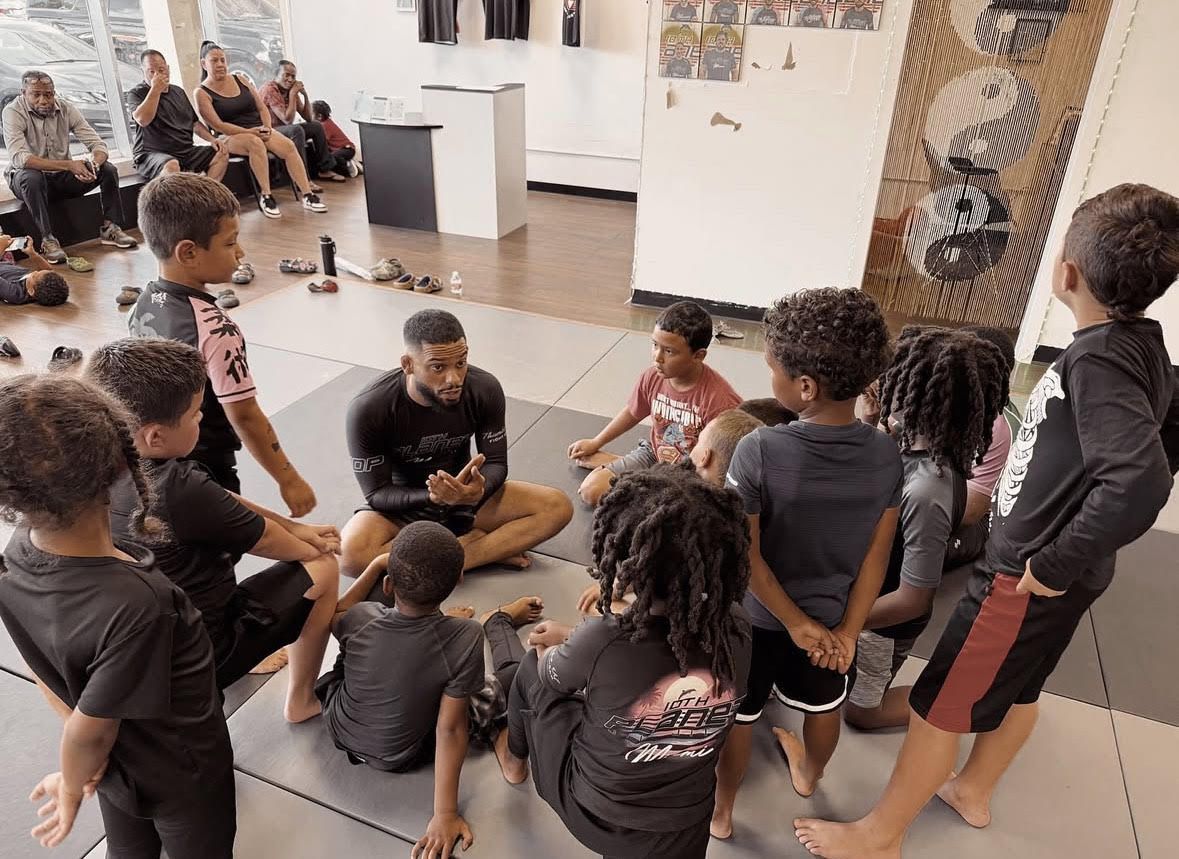
Youth Jiu-Jitsu in Miramar works best when kids learn structure without being overwhelmed. Our youth program for ages 7 to 12 prioritizes safety, coordination, and confidence. We teach movement, positional awareness, and basic control in a way that feels like skill-building, not chaos.
For kids, the goal is not “who can submit who.” The goal is learning how to fall safely, how to create space, how to get back to a strong base, and how to handle contact with composure. Parents often notice better posture, better listening, and a calmer response to pressure. That carries over to school and sports in a very practical way.
Teens benefit from the same fundamentals as adults, just scaled to their stage. As they mature, the training can become more technical and more athletic, but the foundation stays the same: movement first, control second, submissions last.
What to expect in your first month of Jiu-Jitsu in Miramar, FL
Your first month should feel like orientation plus momentum. You will learn the names of positions, but more importantly you will learn how to survive them. Most beginners start noticing progress when they can last longer under pressure and escape one bad spot per round.
We encourage you to show up with a simple goal: get a little better at one thing each class. One day it is shrimping out of side control. Another day it is hitting a technical stand-up without turning your back. That is real progress, even if you still tap a lot. Tapping is part of learning, and it stays safe when you keep your ego out of it.
If you want the fastest path, consistency wins. Two to three classes per week is enough for noticeable improvement. More is great, but steady training beats occasional intensity every time.
Ready to Begin
Building real skill in Jiu-Jitsu comes down to repeatable fundamentals, practiced the same way until your body responds without panic. When you focus on shrimp escapes, technical stand-ups, a clean Americana, a reliable triangle setup, and a structured lockdown half-guard, your game starts to organize itself quickly.
That is exactly how we run our beginner pathway at 10th Planet Jiu-Jitsu Miami: No-Gi focused, detail-driven, and friendly to brand-new students in the Miramar area who want progress they can feel week to week. If you are ready to train, we are ready to guide you.
Train with experienced instructors in a supportive environment at 10th Planet Jiu-Jitsu Miami.